Login

Select travel dates to see prices

Brilliant 4.77rating (7)

Dolphin Behavior and Conservation

location
2 - 2 weeks  ·  Age 18 - 50+
Verified

Highlights

  • Rangiroa Atoll is a world famous scuba diving destination.
  • We focus on close human / dolphin interactions in the context of wildlife tourism.
  • We study each of the dolphins’ history, behavior and temperament, and issues related to their conservation.

Highlights

  • Rangiroa Atoll is a world famous scuba diving destination.
  • We focus on close human / dolphin interactions in the context of wildlife tourism.
  • We study each of the dolphins’ history, behavior and temperament, and issues related to their conservation.
  • "Understand more to care more" is an essential axis of our volunteer program.
  • Rangiroa Atoll is a perfect location to enjoy the kindness of Polynesian people.

  • You don't have to pay anything yet

    Especially good for

    Age 18+
    Singles
    Couples
    Families
    Groups

    About the program

    We look for certified scuba divers to collect demographic and behavioral data on a small bottlenose dolphin community impacted by wildlife tourism.

    THE TUAMOTU ARCHIPELAGO

    The Tuamotu Archipelago (population of 15,000 people), an area highly threatened by climate change, contains 78 atolls spread across an 800,000-square-kilometer ocean surface. It has 800 square kilometers of land for 20,000 square kilometers of lagoon (0.1% and 2% of its ...

    About the program

    THE TUAMOTU ARCHIPELAGO

    The Tuamotu Archipelago (population of 15,000 people), an area highly threatened by climate change, contains 78 atolls spread across an 800,000-square-kilometer ocean surface. It has 800 square kilometers of land for 20,000 square kilometers of lagoon (0.1% and 2% of its maritime area respectively), demonstrating how fragile this oasis of aquatic biodiversity is. The Tuamotu atolls are characterized by their height, shape, exposure to the ocean, population, and the activities performed there. There are small, closed lagoons, both hypersaline and brackish, and large lagoons open to the ocean like Fakarava, which features the largest pass in French Polynesia at 1,600 meters, and even a raised coral atoll, Makatea. Coral growth, which allows these small island reefs of only a few meters in altitude to exist, is directly affected by the slow and irreversible acidification of the oceans (a 30% increase over two and a half centuries). Here, as anywhere else, ecosystems are defenseless against commercial, demographic, and climate pressures.

    RANGIROA ATOLL

    Yet 350 kilometers from Tahiti in the Northwest Tuamotu Islands, the giant atoll of Rangiroa ('Great Sky' in Paumotu), a true oasis of life in the heart of the tropical Pacific Ocean, stretches its 170 kilometers of coral reefs, sands, and coconut trees around a 1,600-square-kilometer area with waters so fish-laden that it has become one of the world's top diving destinations. The atoll's impressive size (80 kilometers long by 20 kilometers wide on average) and its two large channels, Avatoru and Tiputa passes, make it home to marine wildlife as exceptional as it is impressive.

    THE BOTTLENOSE DOLPHIN

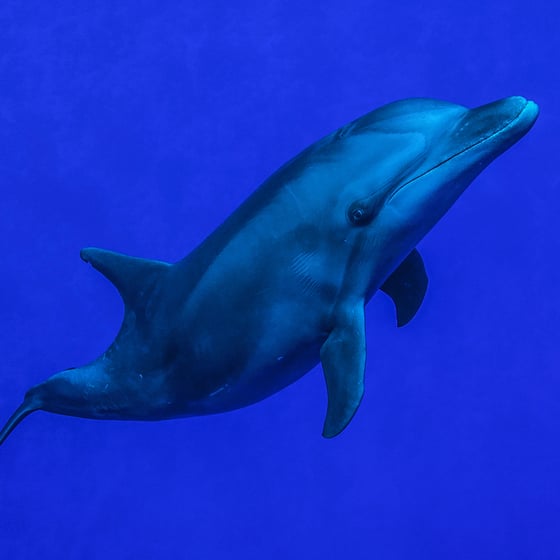
    The common bottlenose dolphin, Tursiops truncatus, is distributed throughout French Polynesia. However, the species is more easily and frequently observed in Rangiroa Atoll than in any other Polynesian island. Here, adults can reach up to 3.3 meters and weigh up to 450 kilos. They are identified by their stocky and grayish body prolongated by a thick rostrum. The line of their mouth, curved upwards, gives them a smiling appearance. Nevertheless, this morphological feature does not reflect the overall species’ behaviors as these dolphins have an extremely complex social life and may display affiliative behaviors such as play and petting behaviors as well as agonistic behaviors (e.g. intimidation, aggression). The numerous scars and notches visible on the adult males’ bodies perfectly illustrate these animals’ strength.

    OUR GOALS

    For many years, scuba divers have been illegally encouraging physical interactions with Tiputa Pass bottlenose dolphins, especially with young individuals. Nowadays, some of the Tiputa dolphins are highly tolerant to humans, making them particularly vulnerable to anthropogenic activities. Indeed, overconfident animals may easily be injured by human activities, or even destroyed if they display intrusive or aggressive behavior toward humans.

    We aim at:

    1. Detecting any deleterious impact of human activities on the dolphin community.

    2. Preventing the risks associated with close repeated dolphin / human interactions.

    3. Sharing results and recommendations to help develop ethical and sustainable dolphin watching activities in Rangiroa and elsewhere.

    WHAT IS THE ROLE OF THE VOLUNTEER?

    First, our volunteers take some time to discover the dolphins' habitats and NGO's monitoring program.

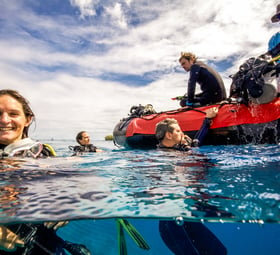
    Then, they are trained to identify the dolphins individually, to spot basic affiliative and agonistic dolphin behaviors, and to help collect underwater and shore-based photo and video data.

    They are asked not to attract or otherwise disturb the dolphins and other marine wildlife, but to adopt a passive attitude underwater.

    After the dives and shore-based sightings, the volunteers enter the data collected into our databases.

    Our 14-day missions need certified scuba divers with minimum an Open Water certification and an experience of 20 dives at sea.

    The volunteers must show their diving credentials before they start diving with us.

    They must be in good physical and mental states, and demonstrate good team spirit.

    They must not be too sensitive to seasickness.

    In order to enjoy the lagoon during free time, we advise them to bring their own fins, mask and snorkel.

    WHAT ARE THE VOLUNTEER ACTIVITIES AND RESPONSIBILITIES?

    1. Underwater sightings

    All the dives are supervised by professional diving instructors.

    Before each dive, a briefing focuses on the dive spot, safety procedures, and marine life.

    Our dive spot is located at a 10-minute boat ride from the dive center.

    The volunteers must remain with their instructor throughout the dive which generally lasts between 45 and 70 minutes. They are invited to take video footage of the dolphins. Divers without cameras may record environmental parameters.

    After the dives, we debrief on the environmental conditions, underwater sightings, dolphins' IDs and behaviors.

    We strongly recommend our divers to bring their own underwater cameras.

    2. Shore-based sightings

    All the shore-based sightings are supervised by DDR's president.

    Long breaking waves (locally called 'mascaret') resulting from a strong tidal current run through Tiputa Pass two times a day. This exceptional setting constitutes a privileged socialization ground for the dolphins which regularly come to surf and leap into the waves.

    This location is perfect to spot and take dolphin pictures without influencing their behaviors and to record information on boats and divers that travel through the dolphins' core habitat. This activity is strongly dependent on currents.

    3. Part of the day is dedicated to data processing, training courses, comments, and debates.

    Depending on the time of the year, our volunteers may be invited to participate in public outreach activities.

    WITH WHOM WILL THE VOLUNTEERS BE WORKING?

    The volunteers are supervised by DDR's president, diving instructors, and captains.

    WHAT DO WE EXPECT FROM THE VOLUNTEERS?

    Our mission is a participative tool for the demographic and behavioral monitoring of a small dolphin community impacted by wildlife tourism.

    It allows our volunteers to better understand the dolphins' routine, issues related to their conservation, and complexity of human / wildlife relationships.

    We expect our volunteers to get involved in our fieldwork to help the NGO sustain its long-term dolphin monitoring program.

    WHAT CAN THE VOLUNTEERS EXPECT FROM US?

    DDR's current president defended a PhD in ethology / behavioral ecology. She has been working on this dolphin community for more than 15 years. She will share her experience and knowledge objectively and with passion. Volunteers usually leave the mission with a new perception of dolphins and their environment. Our captains and diving instructors know the location very well and share their knowledge with great pleasure and spontaneity.

    DO THE VOLUNTEERS HAVE TO BRING SPECIAL EQUIPMENT?

    We strongly recommend the volunteers to bring their own fins, mask and snorkel, a long-sleeve lycra or wetsuit, and an underwater camera. It may be useful to bring a laptop and hard drive.

    We also advise everyone to bring a hat or cap, polarized sunglasses, a seasickness remedy, a raincoat, mosquito repellent, and antibiotic ointment.

    RECOMMENDATIONS

    • Volunteers must be in good physical and mental states, with no heart disease or treatment requiring immediate proximity to hospitals.
    • We strongly advise people who had not dived for more than six months to do a security visit to an ENT and a refresher.
    • Volunteers must be able to live with other people.
    • Adaptability, patience, thoroughness and good humor are welcome.

    GOOD TO KNOW

    • A biometric passport and an ESTA form are required for stopovers in the USA.
    • The voltage used is 220V.
    • All field activities are dependent on the weather and currents.
    • It is prohibited to dive less than 12:00 before a domestic flight and 24:00 before an international flight.
    • Water is always at perfect temperature (between 25 and 29°C). However, you should beware of currents, especially along channels.
    • Avoid swimming at night or wearing shiny jewelry while swimming or diving near the reefs (moray eels, barracudas). We do not recommended swimming in areas where fish have recently been cleaned. Beware of stonefish and do not touch the coral or other animals. Never collect live coral or shells.
    • We recommend wearing a Neoprene suit. You should generally avoid walking barefoot in the water.
    • Be careful of the sun and dehydration. We strongly recommend you to bring a sunscreen, antibiotic ointment, and antihistamine cream.
    • Beware of mosquitoes.
    • Fresh water is a rare and precious commodity in the Tuamotu Islands.
    • The local currency is the French Pacific franc, which is indexed to the euro. €1=XPF 119.33. Cash is handy when you need to buy a sandwich or drink, or take a taxi. ATMs are found at Rangiroa airport and Tiputa village.
    • Rangiroa has a medical center, a private doctor, and a pharmacy.
    • Baggage from overseas must not exceed 30 kilograms.
    • Drugs are strictly prohibited.


    Typical day

    WHAT DOES THE VOLUNTEER DO ON A DAY-TO-DAY BASIS?

    We meet on the first Monday at 10:00 am at the 'Teina and Marie' guesthouse in Rangiroa to introduce you to the team, location and safety tips. The mission then takes place over 14 days (14 nights): one dive is scheduled every day and part of the ...

    Typical day

    WHAT DOES THE VOLUNTEER DO ON A DAY-TO-DAY BASIS?

    We meet on the first Monday at 10:00 am at the 'Teina and Marie' guesthouse in Rangiroa to introduce you to the team, location and safety tips. The mission then takes place over 14 days (14 nights): one dive is scheduled every day and part of the day is dedicated to debriefings and training courses. When the conditions are favorable, we do shore-based sightings.

    The first Sunday and second Monday are free.

    The mission ends on the last Sunday morning.

    ARE THERE SPECIAL WORKING HOURS?

    Field sessions typically last about three hours. Training courses and data analysis typically last about three hours every day. These activities will usually take place somewhere between 7:30 and 11:30 am, and 13:30 and 16:00 pm.


    Free-time activities

    SWIMMING

    In French Polynesia, water is always at perfect temperature. However, you should be careful of currents, especially along channels. We also recommend swimmers to wear a wet suit and avoid walking barefoot in the water.

    SCUBA DIVING

    It is possible to book fun dives.

    HIKING

    Volunteers can ...

    Free-time activities

    SWIMMING

    In French Polynesia, water is always at perfect temperature. However, you should be careful of currents, especially along channels. We also recommend swimmers to wear a wet suit and avoid walking barefoot in the water.

    SCUBA DIVING

    It is possible to book fun dives.

    HIKING

    Volunteers can visit Avatoru and Tiputa villages. They can also book local tours.


    Requirements

    Requirements

    Minimum Age: 18 years

    In order to join the program you need to be at least 18 years old on the program start date. There might be exemptions if you can provide the permission of your legal guardian(s) or if your are accompanied by your parents.

    Language Skills

    You need to speak French (intermediate level)

    Nationality Restrictions

    No restrictions. Helping hands from all over the world are welcome.

    Other Skills

    Scuba divers must have minimum an Open Water or Level 1 certification, an experience of 20 dives at sea, and must have dived less than 6 months before the mission starts​.They must not be too sensitive to sea sickness​.

    Time Commitment

    Your helping hand will be required on Tuesday, Wednesday, Thursday, Friday and Saturday from 08:00 - 16:00

    What's Included

    What's Included

    On-site Services

    - Pick-up and drop-off from Rangiroa Airport to the guesthouse

    - Accommodation in a dorm room (14 nights) at the Teina & Marie guesthouse (you can book a private single bungalow at the guesthouse or a room at another guesthouse but the fees will be higher)

    - Breakfast and dinner

    - Per diem for lunches

    - 10 dives at the 'Rangiroa Diving Center'

    - Training courses, presentations and supervision

    The fees do not include international and domestic flights to Rangiroa and extra expenses - e.g. restaurants, extra dives, excursions.

    Airport Pickup at Rangiroa Airport


    Volunteers are expected at Rangiroa Airport by the guesthouse. The taxi may take some time to come.

    We meet at the guesthouse on the first Monday at 10:00 am.

    Accommodation


    DDR works with the local ‘Teina & Marie’ guesthouse located close to the lagoon, Tiputa Pass, the dive shop, and our dolphin lookout on shore. Accommodation is in a dorm room with shared bathroom fitted with a toilet, cold shower and access to electricity. It is possible to request a private bungalow with hot shower but the fee will be higher.

    This guesthouse is typical from the Tuamotu Islands and may appear too 'roots' for participants accustomed to higher standardsIt is possible for the volunteers to choose a higher standard accommodation located close to our study area (Les Relais de Joséphine, Vaa i te Moana, Coconut Lodge, etc.). However, it is important to book at least six months before the mission starts to ensure availability.

    Our NGO works in partnership with the ‘Rangiroa Diving Center‘, an ethical dive shop located next to the guesthouse.

    Food & Beverages


    Breakfast and dinner are prepared and served at the guesthouse. Local meals are often based on fish.

    Lunches may be organized collectively or taken at a local snack or restaurant.

    Two food stores, three snacks and a small pizzeria are located at a few minute-walk from the guesthouse.

    The shops are relatively well stocked but fruits and vegetables are scarce in the atolls.

    A meal at the snack will cost about 3,000 XPF (USD30 or 25€).

    Liquors are not included in the fees.

    Internet Access

    Limited access at the project site
    You don't have to pay anything yet

    What's NOT included?

    What's NOT included?

    Flight Tickets

    The nearest airport is Rangiroa Airport (RGI) in Rangiroa. We assist you to find cheap flights to French Polynesia. FIND CHEAP FLIGHTS

    Travel Insurance

    Going abroad is an adventure and it is always best to be prepared. Sudden illness or injury, cancellation or theft - a travel insurance for French Polynesia provides security and is a plus to have. GET A QUOTE

    Vaccines

    If you are intending to volunteer in French Polynesia you should seek medical advice before starting your social journey. Check your required vaccinations for French Polynesia. VACCINE CHECKER

    Details on arrival

    International flights to Tahiti often land at night. You may have to book a night at a guesthouse in Tahiti.

    From Tahiti International Airport participants must take a Tahiti-Rangiroa domestic flight (1:00 for a flight without stopovers).

    At Rangiroa Airport you will meet a taxi provided by the guesthouse. The taxi may take some time to be there. The six-kilometer taxi ride between Rangiroa Airport and the guesthouse lasts about five minutes.

    Between 3 and 5 participants are required on each of our missions.

    Please contact us to know the exact dates of our 2026 missions (June, October, and November).

    Availability
    Jan Feb Mar Apr May Jun Jul Aug Sep Oct Nov Dec

    Program Fees

    $1,776 per week 2 - 2 weeks Age 18 - 50+

    Payment methods

    Visa Master Card Maestro American Express PayPal

    NO CREDIT CARD FEES


    Duration

    2 - 2 weeks

    Deposit

    Reserve your spot with just a few clicks and a small, secure deposit. You can pay by credit card, PayPal, or other convenient methods.


    Final Payment

    You’ll agree on the final payment method with your local organization during the application process. This final payment is only due closer to the start of your trip.

    You don't have to pay anything yet

    4.77
    7 reviews

    Location


    Meet your project coordinator

    Pamela
    7
    reviews
    4.77
    Brilliant
    2019
    Founded

    Verified

      Excellent response rate
    Spoken languages: Spanish, English, French
    Travel safely by using Volunteer World for your communication and bookings. This way, you can benefit from the Flex Option, Refund Guarantee, and Resolution Support.

    You might also be interested in

    Contact Pamela
      Excellent response rate
    Spanish, English, French

    Most volunteers ask about


    Do you have any more questions? Send a message to Pamela
    Please don't share personal contact details for your privacy

    Travel dates

    1. - 1. Jan 1

    Book with Flex Option!

    Choose new departure dates or change to a different volunteer program at no extra costs within 12 months.

    Complete Support for Every Volunteer

    This helps us run our platform and offer essential services like Comprehensive Support, Refund Guarantee, Flex Option without rebooking costs, and Price-Guarantee. This includes VAT.

    Price details