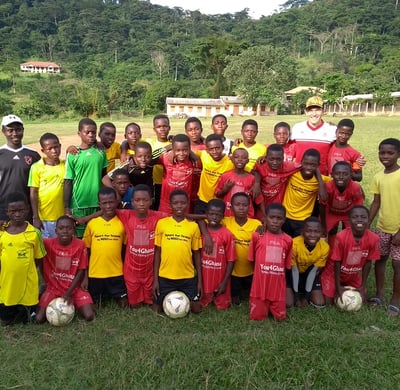
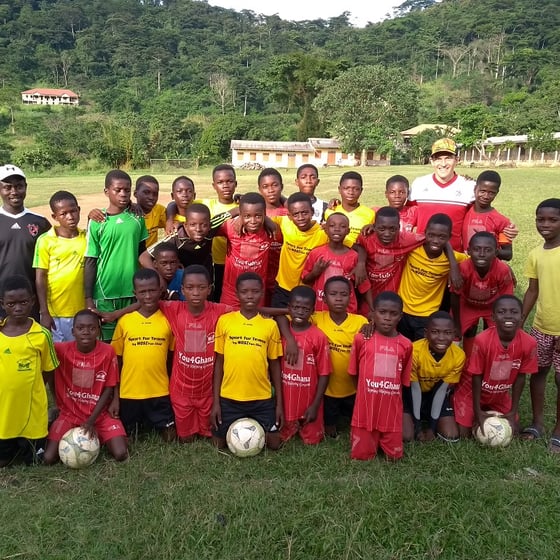
You4Ghana sponsors the Red Lion Soccer Academy since the beginning of
2017. The club consists of a U11, a U13 and a U15 team. We have rented a clubhouse where the players are fed and some also
live. Our two Ghanaian coaches, who also look after the kids, would be very happy to receive support. Training takes place from
Tuesday to Friday and games are played on weekends. The boys who live in the academy can also be tutored or supported in any other way. So if you have some footballing experience and enjoy training, then contact us. The Red
Lions are looking forward to meeting you! Our volunteers are not restricted to one project. If you want to
experience different types of work and get diverse impressions, you are
welcome to work in more than one project. We are looking forward to welcoming you in Ghana!
Before your departure
- A yellow fever vaccination is compulsory for entering Ghana. Make sure that you
have your vaccination certificate in your hand luggage, as it may be checked at
passport control.
- Be sure to seek advice from a tropical institute or a travel doctor about important
vaccinations and malaria prophylaxis!
- In general, everything important for your health can be purchased in Ghana.
However, I still recommend following items for your first-aid kit:
- Imodium (diarrhoea)
- disinfectants
- plasters and bandages
- headache and fever tablets
- ointment against insect bites
- ear plugs for restless sleepers (the animals are often noisy at night)
- In addition, you should not forget the following items:
- clothing for all weather conditions (it can sometimes get quite fresh at night)
- sturdy shoes
- headgear against strong sun
- a thin blanket or duvet cover
- flashlight (power cuts out frequently)
- sunscreen and mosquito protection
- toiletries
- drinking bottle
- tea bags, Nutella, jam etc. for breakfast
- power adapters are available on site
We have a filter coffee machine in our house. However, ground coffee is usually very
expensive in Ghana and can only be purchased in larger cities. Coffee drinkers should
therefore bring a small supply with them.
Life in Ghana
Life in Ghana can by no means be
compared with the Central
European standard and it is quite
normal to suffer a little culture
shock at the beginning. That is why
it is important to be open to new
things and to broaden your
horizons. At the beginning, many
people don't know what to do with
the friendliness of the Ghanaians or
they suspect a trick behind it. But
these are typical thoughts of a
European. Why should someone I
hardly know invite me to their home? Why do they share their food with me when they
have so little themselves? Do they want something in return? These or similar
questions are sure to come up in your mind when you get into such a situation. But
rest assured, the hospitality of the Ghanaians is incomparable. If you like the person,
please accept the invitation and bring a friend with you if you are still a little unsure. As
a guest, everything is offered to you so that you feel comfortable. Refusing something
is considered impolite Even if you try just a little bit of the dishes served, it will make
your hosts very happy. Often people eat together from a large bowl and with their
hands. Make sure you use your right hand for this, as the left hand is reserved for the
opposite. Another aspect that many Europeans are unfamiliar with is the calmness of
the Ghanaians. The clocks just run a little slower in Ghana. A popular motto is: "There
is no hurry in life!". It is quite normal to wait a little longer for someone or something
and the locals will be confused if you get impatient quickly. We do everything to make your stay in the volunteer house as pleasant as possible. In
principle, you don't have to worry about anything. It is catered, washed and cleaned
for you. However, the volunteer house is not a hotel and our employees are not trained
specialists. It will always happen that something is not done. You live there together,
like in a big family. It would be great if you all together make sure that the house is kept
clean and tidy. We rely on the support of the volunteers, especially when it comes to
keeping the bathrooms clean and filling up the water containers. Since the water
capacities are limited, we ask for a water-saving behaviour.
The main method of getting around in Ghana is by taxi. There are two different types
of taxis. The first and recommended variant is "sharing". The taxi has a fixed
destination and only drives off when it is fully occupied. Once the car is moving, people
will continue to get on or off the taxi. Just let the driver know when you have reached
your destination. In this way, you can easily reach all places in the vicinity in the Kwahu
highlands. The journeys take a maximum of 30 minutes and cost between 20 cents
and one euro. There is no taximeter, the prices are fixed from place to place. Ask your
coordinator about prices as some drivers also try to overcharge. The second variant is
"dropping". You look for an empty taxi and let it drive you to the desired destination.
No other people get into the taxi, but you also have to pay for the empty seats. In
addition, a ride in a fully occupied taxi in Ghana is always an experience.
When you travel, you will often use Tro-Tros (small coaches). The prices are usually
fixed and do not have to be negotiated. To get to your exact destination afterwards,
you will often have to rely on taxis. The price should be agreed in advance. Often the
drivers try to overcharge. For a trip of 30 minutes, no more than 1-2 euros per seat
should be paid. In an unfamiliar environment it is of course difficult to estimate how
long you will be on the road. One possibility is to check the distance beforehand with
the navigation system on your mobile phone. However, it is quite normal that you will
pay too much at one point or another. Don't get too upset about it. Negotiating is not
easy, but practice makes perfect! Often it also helps to go to another taxi driver if the
price seems too high to you and bargaining is of no use either. If you want to travel in
a larger group, there is also the possibility of renting your own Tro-Tro, which will pick
you up from the volunteer house and drive you directly to the desired destination. Tell
the team about your plan. They will organize a Tro-Tro for you and help you
negotiate the price.
It's also common for people to ask you for money, especially children. Some volunteers
find this annoying; others find it difficult to say no. No matter which group you belong
to, you get used to that too. In the rarest of cases, one is begged penetratingly. Just
be nice, say no, and move on. You don't need to feel bad about it. You can't help
everyone, even if you'd like to.
Some volunteers also have the idea that they can come to Ghana and save the world.
Once settled, disillusionment quickly ensues. The problems in Ghana are too complex
that one person can hardly do anything about them on their own. Your help is just a
drop in the ocean. I am not writing this to discourage you. I just want you to start your
trip with realistic expectations and not be disappointed. Just try your part to make the
world a little more beautiful. Engage with the people and the culture and try to grow
from the experiences. I hope that the voluntary service will enable the volunteers to
integrate what they have experienced into their everyday life after their return home.
This is just as important to me as supporting the people in Ghana. The trip to Ghana
has already opened the eyes of many. Try to experience your stay consciously.
Hopefully you will learn to appreciate a few things more that most of us take for granted.
You may also question some things that are considered normal in our society.
Finally, I would like to give you a few hints about your safety and some rules of conduct
on your way. The Kwahu highlands are rural and the people are very friendly. You can
move freely there without hesitation. In general, the rest of Ghana is also easy to travel
to and women can also move around freely without any problems. However, if you are
in one of the big cities, you should be a little more vigilant. Poverty is significantly higher
here and so is the crime rate. Europeans are generally seen as rich (which is of course
correct in relative terms). Pickpockets are at work here. Stow your valuables well and
stay in busy places if possible. In the big cities, you should rather decline invitations to
people’s homes.
Also, adhere to the following rules:
- Always travel in groups of at least two people
- Do not travel at night
- Call your coordinator if you are unsure about something
- Don't openly show all of your money when you buy something
- Do not smoke in public (not welcomed in most regions)
- Ask people before you take photos of them
- Please do not invite strangers to the volunteer house without letting the team know
beforehand
- It is always possible to change your project if you are not feeling well
Voluntourism
"I want to get to know a new country and do something good at the same time!" These
are often the reasons for doing voluntary service abroad, often also called
voluntourism. This travel model is becoming more and more popular with young
people. Developing countries are the preferred destinations. However, caution should
be exercised. In the media you hear more and more about the dark side of
voluntourism. If carried out incorrectly, there is a risk of harming the people in the
projects and not helping them.
One of the most famous and harrowing cases is that of Reene Bach. The American
missionary came to Uganda with no previous medical knowledge and treated
malnourished children. Several of her patients died under her supervision. Reene
protests her innocence. She only has wanted to help... That is of course an extreme
example. However, it shows well that goodwill alone is of no use to anyone. Just
because someone comes from a western country does not automatically mean that
they are more qualified than the people in the developing country they are traveling to.
In many cases, the volunteers come to us without any qualifications (apart from schoolleaving qualifications). Would we allow an 18-year-old Ghanaian to work in a
kindergarten in Germany without any training? No of course not. It is therefore very
important that a respectful encounter on an equal footing is practiced. Both sides
should benefit from the cultural exchange.
Another important point is the presentation of the trip on social media. Please refrain
from uploading typical pictures of poverty or pity. This only reinforces the stereotype of
"poor, starving Africa". Rather concentrate on the beautiful sides of the country and try
to present those images at home. Also, do not pose as a saviour. If you are making
the trip just to get praised and for your rÈsumÈ, please reconsider your motivation.
We therefore recommend travellers and interested parties to prepare well for
volunteering, to question their own motivation and to be involved on site for as long as
possible.
One last thing is also very important to me. Nobody who is directly or indirectly involved
with You4Ghana’s projects should ask you for money. That puts you under pressure
and it's hard to say no. If that happens anyway, please report it to me. If you want to
help in your project or elsewhere, it should come from your side. Discuss your idea
with Portia and she will get you a receipt for all expenses. This ensures that 100% of
the money arrives where it should.
Now nothing stands in the way of your trip to Ghana, I wish you all the best and an
unforgettable time!