What is MCC?
Marine Conservation Cambodia (MCC) is a community-based NGO dedicated to protecting Cambodia’s marine ecosystems. Since 2008, we have combined research, conservation, and community partnerships to safeguard the ocean and support sustainable livelihoods for coastal families.
We were the first organization to actively work on marine conservation in Cambodia. Originally based on Koh Rong Samloem, our team conducted research and supported local communities in enforcing fisheries laws to protect marine life and habitats. After successfully helping to establish one of the country’s first Marine Fisheries Management Areas (MFMAs) and being joined by other organizations, the Cambodian government invited MCC to relocate to the eastern coast, where no marine protection efforts existed at the time.
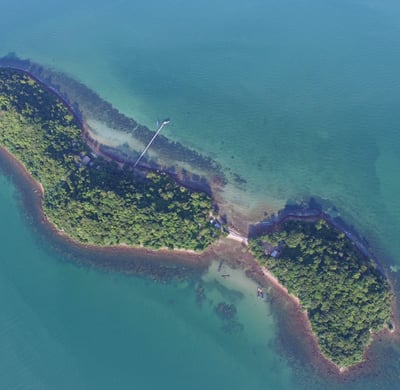
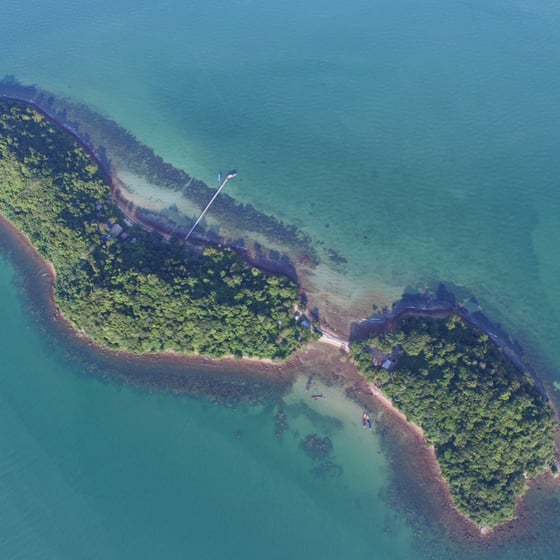
Located in the southern portion of Kep Province, Koh Ach Seh is the most remote island in the Kep Archipelago, lying closest to the Vietnamese border. The island is largely uninhabited, home only to a small marine police station and MCC’s base of operations a quiet tropical haven surrounded by rich marine biodiversity.
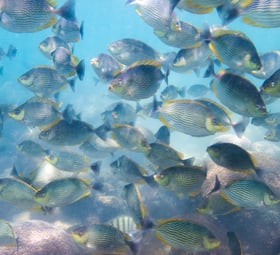
Since our arrival on Koh Ach Seh in 2014, MCC has documented severe damage from illegal fishing. Through five years of research, community collaboration, and policy advocacy, our work led to the approval of the Kep MFMA in 2018, protecting vital habitats such as seagrass meadows, coral reefs, mangroves, and shell beds. Since then, fish stocks have rebounded, habitats have regenerated, and threatened species including the dugong have returned.
Today, MCC manages and protects Koh Ach Seh’s home reef, 13 other island reefs, and approximately 3,000 hectares of seagrass beds across Kep Province. Our ongoing work includes regular patrols, the deployment of Fishery Productivity Structures (FPS) to block destructive trawling, and close collaboration with fisheries authorities, local communities, and policymakers to combat illegal, unreported, and unregulated (IUU) fishing.
Through programs such as seagrass and seahorse monitoring, marine mammal surveys, citizen science, and environmental education, MCC links science, community action, and policy to create lasting change.
Our mission is to protect and restore Cambodia’s marine ecosystems while ensuring that the people who depend on them can continue to thrive. By combining science, conservation, and collaboration, MCC is building a healthier, more sustainable future for Cambodia’s ocean and the communities that call it home.
MCC projects
Due to our constantly evolving environment and context, MCC’s projects change regularly. For all these projects we can provide full training and support to get you up to a level where your collected data can and will be used within MCC’s reports and publications.
The Cambodian Marine Mammal Project:
Our Marine Mammal project is a research-led and community-based project working towards safeguarding Cambodia’s endangered Marine Mammals with a current focus on the Irrawaddy dolphins and Dugongs of Kep Archipelago. It is currently the only long-term study of Cambodia’s marine population of the endangered Irrawaddy dolphins. In 2022, we expanded this work to the neighboring province of Kampot and now include the Indo Pacific Humpback Dolphins as part of our research program. This program is headed by Cambodian researchers under the supervision of a Marine Mammal Scientist.
Seagrass Monitoring Project:
Cambodian Seagrass Conservation Project is working to protect and expand seagrass meadows in Cambodia’s coastal waters, while also helping the local communities that rely on seagrass-related resources. This project aims to map the extent, species composition and abundance of seagrasses across Kep and Kampot provinces. Starting at Koh Seh, the seagrass project works to better understand seagrass ecology over different temporal and spatial scales, including assessments of species growth rates, reproductive cycles and response to damage. Working with the seagrass squad you would contribute toward directing protected area zone management, identify biodiversity hotspots and threat-spots, and inform strategies for meadow expansion.
The Cambodian Seahorse Project:
The Cambodian Seahorse Project conducts surveys around Koh Ach Seh to study seahorses and their habitats. The project aims to document species composition, population abundance, distribution, and habitat use, identify and protect critical areas such as seagrass meadows and provide scientific data to support conservation efforts while raising awareness of the threats these species face.
Outreach Project:
Working with local schools and universities, we provide advocacy and education on marine research and conservation, our local university internships, have produced some of Cambodia’s leading marine conservationists and researchers.
Marine Litter and Plastics Project:
Ocean plastics and rubbish is an increasing problem. Our team organizes local cleanups and attempts to address ocean pollution on a local scale.
Alternative Livelihoods:
Marine Conservation Cambodia is actively working on providing alternative livelihood solutions for local communities. Due to the decline in the overall fisheries resources, it is essential that alternatives to illegal and destructive fishing are found. By looking at socio-demographic and our marine data, we can begin to identify possible solutions for livelihood improvement and alternative livelihoods.
What does volunteering with MCC mean?
Being part of Marine Conservation Cambodia (MCC) means joining a passionate, fast-paced, and hands-on team working together for marine conservation. Life on Koh Ach Seh is unique, an immersive experience where daily living and conservation work go hand in hand. You’ll be part of a close-knit community where everyone contributes, whether it’s helping with island upkeep, assisting in the field, or supporting research activities. These shared efforts build strong bonds, personal growth, and a deep sense of purpose.
Volunteers play an active role in all aspects of our projects, and the experience is both challenging and incredibly rewarding. The tropical climate, remote setting, and physically demanding tasks add to the adventure, and make the moments of achievement, discovery, and connection even more meaningful. Living so close to the ocean offers experiences you’ll never forget, surrounded by the natural beauty of Cambodia’s coastline.
While life on the island isn’t a relaxing getaway, it is a rare opportunity to learn about marine conservation, ocean ecosystems, and Cambodian coastal culture in a truly hands-on way. You’ll gain resilience, teamwork, and field experience, while making a tangible contribution to protecting Cambodia’s marine environment. Along the way, you’ll develop practical conservation skills such as research diving, data collection and analysis, and field survey techniques which are all essential tools for a future in marine science and conservation.
Bungalows:
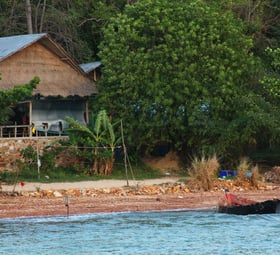
While living on Koh Ach Seh, you will stay in gender-divided bungalows shared between two to six people. Staff and volunteers have separate accommodations but live close together as neighbors. Each room includes three bunk beds with mosquito nets, power and lighting at night, and an en suite bathroom with a bucket shower and toilet. Life on the island is simple and close to nature, but you will quickly get used to the rhythm of the ocean and the unique experience of living surround by nature.
Internet:
We have no Wifi on the island and use personal mobile data if we want to access the internet. If you need or want internet access while you are here, the best Cambodia networks with data signals on the island are either ‘C-Tel’, ‘Smart’ or ‘Metfone’ with varying reliability in different places. If you are coming from Vietnam, we would strongly advise you to buy a Vietnamese Sim card, namely ‘Viettel’ since the Vietnamese data signals are way stronger. Don’t expect to be able to stream Netflix, the signal is mostly too unstable for that. Buy a 4G sim card on the mainland ($1 to 4, available at every market or tech shop), buy some top up cards and type in the code shown. You then need a code to convert the money into data, kindly ask the employees at the shop to help you do this, choose whichever plan suits you. Many of our staff/volunteers are on the $5 plan which lasts for a month and is 50GB or $1 which lasts for 1 week.
Emergencies:
Living on our island, we are fortunate to have quick access to the mainland, as it only takes 20 minutes by speed boat to reach necessary resources and medical assistance if needed. While we do have a species of venomous snakes here, it is essential to remember that their bites are not deadly. We have never encountered any issues with snake bites, and we strive to maintain a safe environment for all residents. Nevertheless, it is always wise to exercise caution and take necessary precautions to prevent potential emergencies. We understand that emergencies can occur unexpectedly, and we are prepared to handle them efficiently. In urgent situations, we have the option to utilize the speed boat for immediate transportation to the mainland. However, it is important to note that this mode of transport is strictly reserved for genuine emergencies. For regular illnesses or non-life-threatening conditions, our standard practice is to wait for the next planned boat trip to the mainland.
Transport to and in Cambodia:
We would advise downloading either the ‘Pass’ or ‘Grab’ App for Tuk Tuks, they are very easy and act like Uber, where you can book online and they come within a few minutes. Booking a Tuk Tuk driver by hour is also an option. Using apps like these also provides protection of being overly charged and can generally be used as a guideline for prices. Please be aware that there might be no drivers for these Apps in more remote areas, but don’t worry. You will always find a Tuk Tuk or a way to get around. You can also rent a scooter for a reasonable price, but please be aware that driving, roads and traffic in Cambodia is quite different in comparison to Western countries and can be dangerous. Please also note that it might take longer than usual to get through the airport in Phnom Penh, so allow plenty of time for this before your destined time of departure to Kep or elsewhere. Remember: if you need a negative PCR result to fly home, you will need to test in Phnom Penh with enough time to be authorized for travel e.g. leave the island two days before your flight.
Recommended accommodation in Phnom Penh:
● Cheap: Top Banana Hostel
● Mid-range: YK Arthouse or House Boutique Eco Hotel
● More Expensive: Okay Boutique
Transport to Kep:
There are mainly two good ways to get from Phnom Penh to Kep city:
Taking a Tuk Tuk from the airport to Phnom Penh city center ($10) and afterwards a Bus from Phnom Penh city center to Kep city($10 ticket; duration 4h). It’s best and easiest to book online via bookmebus or a similar website, even though you can just turn up at the any bus center and ask for an available seat on the next bus.
Taxi is also an option; it is faster but more expensive ($50-60) and can be booked via bookmebus or a similar website as well.
Recommended accommodation in Kep:
● Cheap: Khmer House Hostel or Captain Chim’s Guesthouse
● Mid-range: Khmer Hands Guesthouse or Botanica Guesthouse
● More Expensive: The Beach House
Transport to Koh Ach Seh:
Only MCC’s supply boat travels to Koh Ach Seh, so no need to purchase a ticket. Our boat leaves at 3:00 pm from Rabbit Island Pier in Kep Town every Wednesday, Friday and Sunday. Our days of arrival are every first and third Sunday of the month. MCC’s supply boat is red and black and different to the normal green boats parking at the Pier. If you can’t find it, just ask anybody for the boat to the conservation on Koh Ach Seh. If you tend to get motion sickness, it's important to bring medicine for boat rides. It can really help you feel better and have a more enjoyable time on the water.
Visa:
DO NOT get the tourist visa. You need to go to the visa desk on arrival and ask for a 1 month E-Visa that can be extended if needed in the country, the cost is between 40-45$. It is best to have a photocopy of your passport and two passport photos, sometimes they ask for them, sometimes they don't, but better to be prepared.
Costs:
We know that cost is often a deciding factor and sometimes the greatest contributors of passion and energy struggle financially, as we often do. If we were located on mainland Cambodia, our cost would be definitely lower but being on a near desert island we need to bring everything by boat. There is no continuous electricity (generator at night), other accommodation, market or restaurant on the island, which means higher general costs, but next to nonextra costs, provided you stay on the island.
The first 4 weeks are to be paid prior to arrival to reserve your place and help us prepare. The price also goes lower the longer you stay and the more you contribute to the team. Staying with us for a longer time means you have learned more skills that are useful to our work and that also means a greater contribution on your part. If you stay longer than 3 months with us, we can work out a payment plan with you.
The price includes everything provided on the island:
● all food, water, tea, coffee
● accommodation
● transport to and from the mainland to Koh Ach Seh
● research training in current projects
● all scuba diving (if qualified)
We are not a business and we are reinvesting all the money we can get to save the archipelago and its unique ecosystems... Therefore, all of us are all living with a very basic level of material comfort, same as you.
If you can’t afford those fees, let us know how you can make positive changes to the ocean in Cambodia and we will try to work something out. Please remember though that your contribution is what keeps the wheels turning and allows not only you but also us, to continue making a difference and changing the tide of destruction that affects our Oceans.
Diving:
As you might have realized already, many of our activities happen underwater for which you need an Open Water Qualification combined with two specialty courses, Navigation and Perfect Buoyancy or and Advanced Open Water or above (SSI), Advanced Open Water Diver (PADI) or equivalent certification to dive around here. Provided you have this level of experience, all diving on the island is for free and in theory unlimited. As long as there’s time and you find a fitting dive buddy, you can explore the reefs and areas around the island as much and as often as you want.
If you do not have those certifications yet, you will be at the best place to earn them as we have a highly qualified and experienced diving instructor team on the island. Our team is also happy to perform a test dive with you, to help you make the right decision for you. Please keep in mind, that due to pollution and the water quality in general the visibility is not great and with some minor exceptions the depth doesn’t exceed 10 meters.
The diving course fees are extra over the volunteer contribution as follows:
● SSI Open Water Diver course is 375 US$
● SSi Open Water and two Specialties (Navigation and Perfect Buoyancy) is 625 US$
● SSI Open Water Diver and SSI Advanced Open Water course combined 650 US$
● SSI React right course is 150 US$
● SSI Rescue Diver course is 450 US$ (SSI React right needed)
You can either transfer the money into the same bank accounts as the general fees or pay in cash, whatever works best for you.
Packing 101:
● Personal laptop
● (video-) camera; useful in certain projects and for capturing memories
● Binoculars, if you have some
● Mosquito repellant
● Sun cream
● Soap, shampoo/conditioner, general cosmetics
● Sunglasses and hat
● Rain jacket/umbrella
● Swimming clothes (no bikini)
● Wet suit (3mm) or rash vest
● Clothing; short and long clothes for mosquito protection recommended, quick-dry
● Shoes; airy but well fitting slippers possibly with extra ankle band recommended
● Adapters
● Portable charger
● USB stick / portable hard drive
● Stationary (pens, pencils, pencil sharpener, eraser and writing paper)
● A photocopy of your passport, your Visa (if possible) and two passport photos
● If you are diving, definitely bring a mask, snorkel and either shoe/closed heel fins or booties to fit into an open heel fin, and any other dive equipment you have; there are possibilities to borrow equipment but it’s better to bring what you have
● First aid kit
● Toilet Paper (if needed)
● Face masks
Island and Cambodian etiquette:
● Smile
● Learn some Khmer
● Learn how to toast Khmer style
● Do not give or receive anything with the left hand
● If handing something to an elder, use both hands
● Do not sit higher than an elder
● Do not point at anything with your index finger (use your fully extended hand)
● Do not cross a social circle or people having a conversation (or at least bow if you need to)
● Never touch somebody’s head
● Do not step over somebody’s leg
● Do not put the sole of your feet toward somebody
● Remove your shoes when entering the Main Bungalow and the kitchen
● Dress appropriately: our team is made up of a mixture of Cambodian and western staff, for this reason it is important to dress accordingly and respectfully. Women should wear a swimsuit when swimming (not a bikini) and ideally a t shirt and shorts too