Program Overview: Nunnery & Monastery Supporter Program
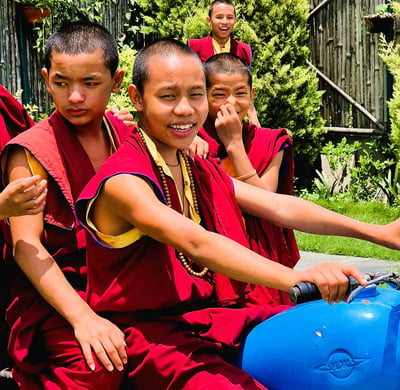
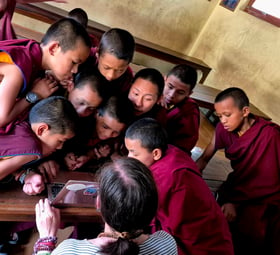
This immersive program bridges the gap between ancient spiritual traditions and global education. As a volunteer, you will step directly into the peaceful, structured world of Buddhist monastics, working with monks or nuns who range from young children to young adults. Your primary role is to empower these students by teaching English, basic computer literacy, math, or creative arts, providing them with essential tools to navigate and communicate with the modern world.
Beyond structured classroom hours, you will become part of the community—whether that means playing sports during free time, supporting environmental greening projects, or sharing ideas during informal conversational sessions.
Core Program Details
Work Schedule: 6-day working week (Sunday to Friday).
Daily Commitment: Typically 3 to 6 hours of daily service, primarily centered around afternoon classroom blocks.
Free Time: Saturdays are completely free to explore the surrounding cultural sites and breathtaking landscapes.
Accommodation Paths: Choosing Your Lifestyle
The program offers two entirely distinct living experiences. Whether you prefer the buzzing social energy of a global volunteer hub or the deep, quiet contemplation of an active spiritual center, you can tailor the journey to your personal goals.
Path A: The Vibrant Local Homestay ExperienceThe Urban-Local Advantage
Most of the major Buddhist monasteries and nunneries are located on the quiet, rolling outskirts of the Kathmandu Valley. By choosing a homestay right within the vibrant urban heart of Kathmandu, you gain a unique advantage: you get to experience the real, everyday civilian life of the city like a true local, while commuting to your peaceful monastic placement during the day.
Comfort, Flexibility & Spiritual Access
Accommodation standards in our local homestays are slightly better and offer more modern comforts (such as more consistent facilities and western-style features) compared to the very basic, disciplined guest quarters inside the monasteries.
Even while living at a homestay, you don't have to miss out on the spiritual elements. Because the monasteries are just a short 15 to 20-minute journey away, you have the flexibility to head over early for morning prayers or stay late to join the community for evening chantings.
A Typical Day on the Homestay Track
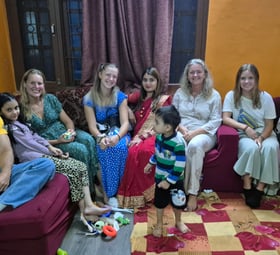
Your morning begins at 07:30 AM with a fresh, home-cooked breakfast alongside your host family and a global peer cohort of fellow international volunteers. Before your teaching service begins, you will ground yourself with a dedicated morning yoga session from 09:00 AM to 11:00 AM, focusing on mindfulness, breathing, and flexibility.
At 11:30 AM, everyone gathers around the dining table for a hearty, traditional lunch (often authentic Dal Bhat) prepared fresh by your hosts. Following a brief 15–20 minute commute at 12:30 PM, you will step into the monastery classroom from 01:00 PM to 04:30 PM to lead your core teaching shifts.
Your late afternoons and evenings are packed with culture and connection: you can lace up your boots for daily hiking opportunities on beautiful local trails weaving through the valley's surrounding green hills, wander neighborhood markets with peers, or jump into the kitchen for hands-on cooking classes to learn the secrets of folding the perfect momo (Nepali dumpling). The day concludes at 07:30 PM with a large, lively communal dinner with your host family.
Path B: The Immersive Monastic ResidenceLiving the Monastic Rhythm
If your goal is absolute spiritual immersion, staying directly in the monastery or nunnery guest quarters offers an unparalleled window into an ancient way of life. You will live, eat, and breathe alongside the monastics, experiencing an environment of profound simplicity, discipline, and peace.
Experiential Learning
By observing and participating in their daily discipline, you will learn the philosophies of Tibetan Buddhism, mindfulness, and community-first living directly from your hosts.
A Typical Day on the Monastic Track
Life inside the monastery gates moves to a deeply spiritual rhythm, beginning before dawn when the resident monastic gong echoes through the halls at 04:30 AM. Novices and guests gather from 05:00 AM to 06:30 AM for the powerful early morning Puja (chants, prayers, and meditation rituals) in the main hall. A simple, communal breakfast of Tibetan bread, chickpea curry, or milk tea is served at 07:00 AM, followed immediately by the core morning academic teaching block from 08:00 AM to 11:30 AM.
After sharing a collective, vegetarian lunch with the resident monastics, you will have a peaceful two-hour window for personal reading, reflection, or rest in your private living quarters. From 01:30 PM to 04:00 PM, service resumes with specialized afternoon practical workshops, basic computer literacy classes, or one-on-one homework tutoring.
Late afternoons are reserved for joyful connection, coordinating recreational recess time, and playing football or volleyball in the monastery courtyard from 04:00 PM to 05:30 PM. As the sun sets over the hills, you are welcome to attend the peaceful evening chants at 06:00 PM, followed by a simple communal dinner at 07:00 PM and a quiet evening of lesson planning before lights out.
The Best of Both Worlds: The Hybrid Track
Can't decide between the two? We've got you covered. You can easily balance both experiences by opting for a split schedule—for example, spending two weeks in a vibrant homestay to soak up the local culture of Kathmandu, followed by two weeks living directly inside the monastery for deep, spiritual reflection.
Weekends & Free Time: Exploration and Adventure
Your Saturdays are entirely your own, and we ensure you make the most of them. Because our program brings together volunteers from all over the valley, it serves as the perfect launchpad for collective exploring.
Free Weekly Weekend Hikes: In addition to the daily trails available right from your doorstep on the homestay track, we organize free, guided group day-hikes every single weekend into the lush, expansive national parks and ridges surrounding the Kathmandu Valley (such as Shivapuri, Champadevi, or Nagarjun). It’s a fantastic opportunity for all volunteers to come together, get some fresh mountain air, and see the valley from above. ( this opportunity will be for those staying in home stay)
Customized Day Tours: During your free windows, you and your fellow volunteers can easily plan day trips to Kathmandu’s iconic UNESCO World Heritage sites. Step back in time among the ancient palaces of Patan and Bhaktapur Durbar Squares, spin prayer wheels at the Swayambhunath (Monkey Temple), or witness the deep spirituality of Boudhanath Stupa.
Accommodation Note: While homestays provide slightly better comfort, daily hiking options, morning yoga, a peer community, and hands-on cooking classes, staying directly inside the monastery quarters offers unparalleled access to quiet spiritual practices. Choose the homestay for an active, flexible, and adventurous social track, or the monastery for profound personal reflection—or combine both for a comprehensive experience!
Background: Himalayan Buddhism & Monastic EducationA Small Background on Himalayan Buddhism
Himalayan Buddhism—primarily practicing Vajrayana (Tantric) Buddhism—is deeply woven into the geographic and cultural fabric of the high-altitude regions stretching across Nepal, Tibet, Bhutan, and parts of India. Originating from ancient Indian Buddhist traditions and masterfully synthesized by sages like Guru Rinpoche in the 8th century, it is distinct for its colorful rituals, sacred chants (Puja), and profound focus on logic, compassion, and mindfulness.
In these mountain communities, the local monastery (Gumba) or nunnery isn’t just a house of worship; it functions as the absolute beating heart of the community, serving as a town hall, a spiritual sanctuary, and historically, the only center for literacy and medicine.
How Monks Come to the Monastery for Education
For centuries, Himalayan families have followed a deeply respected tradition of sending at least one child (often the second son or daughter) to enter monastic life. Today, young monks and nuns typically enter the monastery between the ages of 5 and 8.
While the choice is rooted in immense religious merit and cultural pride, it is also deeply practical. For many families living in remote, high-altitude mountain villages where public schools are nonexistent or inaccessible, sending a child to a monastery guarantees:
A stable, safe environment with free clothing, housing, and food.
A high-quality, comprehensive education that they otherwise could not afford.
The Evolution of Monastic Education
Once a child enters, they step into a dual-world educational structure that beautifully blends the ancient with the modern:
The Traditional Core: Young novices begin by learning the Tibetan and Nepali scripts. Their early years are intensely focused on memory and discipline—memorizing long lineages of sacred texts, scriptural verses, and prayers by heart, which they recite to senior teachers. As they grow older, they transition to advanced philosophy, complex logic, and the famous, highly energetic art of monastic debate.
The Modern Integration: Today’s monasteries recognize that these young monastics must also be equipped to navigate the modern world. Alongside their spiritual studies, modern monastic schools integrate standard secular school curriculums. Monks and nuns now sit in classrooms to learn Mathematics, Science, Social Studies, and Languages (Nepali and English).
This is exactly where the volunteer program creates an impact. While the resident lamas excel at teaching ancient philosophies, international volunteers fill a vital gap by offering immersion in conversational English and basic computer skills—ensuring these young monastics can ultimately grow into globally minded leaders, scholars, and community guides.