Login

Sélectionne les dates de voyage pour voir les prix

Exceptionnel 4.90rating (8)

Native Forest Conservation in a Kiwi Sanctuary

location
2 - 26 semaines  ·  Âge 18 - 50+
Vérifié

Points forts

  • Learn how to protect endangered species
  • Get real life experience in the conservation field
  • Experience living in a rain forest

Points forts

  • Learn how to protect endangered species
  • Get real life experience in the conservation field
  • Experience living in a rain forest
  • Live off grid in a sustainable way
  • Connect with like-minded people

  • Aucun paiement à cette étape

    Particulièrement approprié pour

    Âge 18+
    Seul voyageur
    Couples
    Groupes

    À propos du programme

    Help protect this beautiful jungle-like forest and to create a safe environment for the kiwi!

    Across New Zealand, an estimated 27 kiwi are killed by introduced predators every week. Pupu Rangi is one of the organizations working to change that number. Predators - stoats, possums, and rats - arrived recently with humans in a world where the kiwi lived in forests with no mammals for over 80 ...

    À propos du programme

    Across New Zealand, an estimated 27 kiwi are killed by introduced predators every week. Pupu Rangi is one of the organizations working to change that number. Predators - stoats, possums, and rats - arrived recently with humans in a world where the kiwi lived in forests with no mammals for over 80 million years. Today, these introduced species are modifying the landscape and they are endangering the survival of 75% of the New Zealand native species.  

    Pupu Rangi is a 100-hectare off-grid sanctuary on the Kauri Coast, Northland — 250 km from the nearest city, 50 km from the nearest supermarket, and 1.5 km from the nearest neighbour. A maximum of eight participants at any one time are doing serious conservation work to protect all native species that live within. This is not an injured wildlife sanctuary near a city. It is an off grid camp next to forests where no one has walked in generations. You will be among the first people to enter it.

    You should come and join us!

    What you can expect

    The Pupu Rangi Nature Sanctuary welcomes you to this place of learning: about the forest and its creatures, about conservation, about what is important in life, and about yourself. You will be challenged on many fronts: living off-the-grid, working in a dense rainforest forest, questioning the need for many of the things that we take for granted. You will meet people from various countries and different backgrounds and together with them you will experience something that is rare these days: the expanse of an uncharted forest which you and your fellow volunteers will help preserve.

    While at the sanctuary you will have the opportunity to learn about different aspects of life (living in tune with nature, discovering what is really important to you, what other cultures value most), to get some practical skills (planning, setting priorities, using creativity to find solutions within the available means), to learn about New Zealand native species and the different ways to protect it, to understand what it takes to live in a sustainable way, and to explore the attractions in the surrounding region. Body and mind will both be exercised and enriched.

    The program

    This program has three components: the conservation work that we do in the forest, the manual work that we do around the sanctuary, and the sightseeing that we do around the region.

    Volunteer work

    Some of the tasks that you will complete are:

    • cutting and marking tracks
    • installing, refilling, and monitoring bait stations
    • installing and monitoring traps
    • kiwi, kokako, and rodent monitoring
    • seed collection
    • weed control and planting of native plants
    • data entry

    The conservation tasks that we perform in our sanctuary and on the behalf of the Department of Conservation (DOC) are performed at a professional level, and you will receive the training necessary to reach the required high standard. 

    Week 1–2: You learn the protocols. Navigate the dense forest, look after your safety, predator control, trail camera kiwi monitoring using DOC methodology. You'll be working alongside an experienced conservationist from day one — not observing.

    Week 3–4: You know the forest. You're running trap checks by yourself, you can confidently go further in the forest, you spend the nights alone in the forest listening for kiwi. Participants consistently say week three is when the experience changes.

    Week 5+: For those who want to go further, extended stays and formal internship pathways are available — including a university placement letter and skills log.

    Manual work

    The manual work part of the program refers mostly to the activities that we have to perform to maintain and enhance the living area. It is most likely that most of the tasks that you will have to perform will be new to you. We will train you and you will use your creativity and previous skills to find ways of completing the tasks.

    Tasks include:

    • weeding and maintaining the herb garden
    • building maintenance tasks (i.e. painting walls, setting up walls)
    • landscaping
    • chopping wood
    • general help around the place

    Previous volunteers helped us paint the accommodation buildings, start a herb garden, paved a patio area, built sheds, erected fences, and built an outdoor bath.

    Every month, week, and day has its own target tasks to complete be it monitoring, track cutting, or some facility improvement. In general, we aim to find a balance between the conservation and maintenance tasks.

    Relaxation

    The third component of the program consists of the relaxation activities that are so important to recharge one's batteries. We believe that it is important for each volunteer to see the extent of their contribution in the wider context of the Kauri Coast region. We are also proud of the beauty of this land and it will be our pleasure to share it with you. 

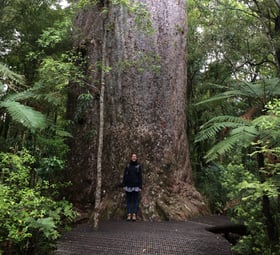
    At night we might go on a safari looking for kiwi, these three hour night walks are an amazing opportunity to hear the sounds of the forest and let the stars guide us. Sometimes we also go deep in our forest to visit the glowworms that live near one of the waterfalls. There is nothing as magic as sitting in the dark by the creek and watch the tiny blue lights of these amazing creatures. One day a week we head to the lakes for some swimming or SUP practice, or we head for a long beach walk (or mountain climb), or we visit the amazing two thousand year old Tane Mahuta - the oldest and biggest tree in New Zealand.

    Why Pupu Rangi, not Australia or another New Zealand programme? Australia's conservation programmes put you near a city, caring for animals in enclosures. Other New Zealand programmes are city-based rotations in Auckland or Christchurch. Pupu Rangi is field conservation in the animals' actual wild habitat — predator control, kiwi monitoring, habitat management — in a forest closed to the public. The methodology you'll learn is used nowhere else on Earth.


    Journée typique

    Typical Day at Work 

    • 8am - 9am breakfast
    • 9am - 10am cleanup
    • 10am - 12pm morning working activity
    • 12pm - 1pm lunch/picnic
    • 1pm - 4pm afternoon working activity
    • 4pm - 6pm leisure activities (free time)
    • 6pm - 8pm dinner
    • 8pm - 10pm leisure activities (sunset watching, dusk bird chorus, and/or searching for ...

    Journée typique

    Typical Day at Work 

    • 8am - 9am breakfast
    • 9am - 10am cleanup
    • 10am - 12pm morning working activity
    • 12pm - 1pm lunch/picnic
    • 1pm - 4pm afternoon working activity
    • 4pm - 6pm leisure activities (free time)
    • 6pm - 8pm dinner
    • 8pm - 10pm leisure activities (sunset watching, dusk bird chorus, and/or searching for kiwis on a night safari) 
    Each working morning, depending on the weather, we clarify which tasks will be performed for the day. As a rule of thumb: if it is windy, we go in the forest (where there is protection and warmth), if it is calm, we stay in the living area. We always work in a group for safety and for the pleasure of each other's company.

    Please note that generally Monday is a day off. Depending on the weather, we will pick a day during the week during which we will go sightseeing around the region. 


    Activités de loisirs

    Due to our remote location, there are no opportunities to go to town or to the cinema during the free time. However, we have a cinema on site!

    During the free time, the volunteers are encouraged to explore our forest. 

    We always eat together and sometimes we invite the DOC rangers or the neighbours ...

    Activités de loisirs

    Due to our remote location, there are no opportunities to go to town or to the cinema during the free time. However, we have a cinema on site!

    During the free time, the volunteers are encouraged to explore our forest. 

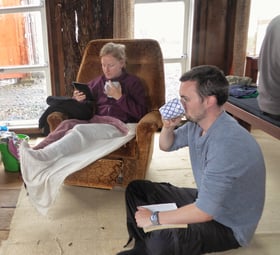
    We always eat together and sometimes we invite the DOC rangers or the neighbours for dinner. At night we can organize a movie night in our recreational room. 

    Monday is almost always a free day and the volunteers might have the opportunity to relax around the sanctuary.

    One day a week, we will head out on an adventure either to to swim at the nearby Kai Iwi lakes, go for a walk on the beach, or visit the two thousand year old kauri tree that lives close to the sanctuary.


    Conditions

    Conditions

    Âge minimum: 18 ans

    Pour participer à ce programme, tu dois avoir au moins 18 ans au moment du début. Des exceptions peuvent être possibles si tu fournis une autorisation de ton représentant légal ou si tu es accompagné(e) par l’un de tes parents.

    Compétences linguistiques

    Tu dois parler Anglais (niveau moyen)

    Documents requis

    Letter of Motivation (not AI generated) and CV

    Restrictions de nationalité

    Aucune : l’aide venant du monde entier est la bienvenue.

    Autres Compétences

    Building skills or outdoor guiding skills will be an asset

    Engagement horaire

    Nous avons besoin de ton aide pour mardi, mercredi, jeudi, vendredi et dimanche de 09:00 - 16:00

    Services inclus

    Services inclus

    Services sur place

    The fees include accommodation, meals, training, safety equipment, all transportation while with us, sightseeing trips around the region (to the lake, beach, etc...), and transfers to/from the closest town (Dargaville).

    Volunteers will be responsible for their flight costs, airport transfers, transportation to Dargavile, and accommodation before the start of the program.

    Logement

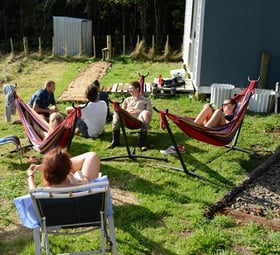
    Our facilities are basic but functional. One of the principles behind our sanctuary is to be as kind to the environment as possible. We are off-the-grid and we try to use as little resources as possible. The main facilities (kitchen, showers, dinning room) are housed in recycled shipping containers. We reuse as much second hand material or furniture as we can find. 

    The accommodation is in a small cabin and consists of bunk beds. 

    Small items can be washed in the sinks and we do a load of washing once a week. The cleaning of the facilities is part of the daily tasks that each participant has to complete.

    Please note that we are off the grid and do not have electricity or running water. It is best to work on the assumption that you will be able to charge your mobile phone only once a week. Please note that the use of mobile phones is not allowed between 8am and 4pm (except for taking pictures).

    Aliments & Boissons

    Breakfast, lunch, and dinner are provided. Most of the meat that we eat is organic beef, and we also have organic milk, butter, and cheese. We also have honey that was produced from the trees in our forest.

    We accommodate vegetarians and gluten free diets. Please note that we are not able to cater to vegans due to the high level of energy required by the participation in our program.

    The drinking water is from filtered rain water. Volunteers are encouraged to plan on bringing their own snacks or any non-alchoolic drinks that they will require.

    Please note that alcohol is not permitted in the sanctuary.

    We are not able to accommodate smokers due to the risk of fire to the forest.

    Accès à Internet

    Accès limité sur le site du projet
    Aucun paiement à cette étape

    NE SONT inclus dans le prix:

    NE SONT inclus dans le prix:

    Transfert de l'aéroport Auckland Airport

    Le transfert de l'aéroport n'est pas inclus dans les frais non plus.

    Billets d'avion

    L'aéroport le plus proche est Auckland Airport (AKL) à Auckland. Nous t'aidons à trouver des vols pas chers pour aller en Nouvelle-Zélande. TROUVER DES VOLS PAS CHERS

    Assurance voyage

    Partir à l'étranger est une aventure et c'est toujours mieux d'être bien préparé. Que ce soit une maladie soudaine, une blessure ou du vol - une assurance voyage pour Nouvelle-Zélande te protège en cas de situation imprévue. OBTENIR UN DEVIS

    Vaccins

    Si tu envisages de faire du bénévolat en Nouvelle-Zélande, nous te conseillons de consulter un médecin avant le début de ton voyage. Renseigne-toi sur les vaccins nécessaires pour Nouvelle-Zélande. INFOS VACCINS

    Informations sur l'arrivée

    The nature sanctuary is open from the first Monday in November until end of March. Due to our remote location, you can join (or leave) the program on Mondays only.

    The start dates are on the first and third Monday of every month.

    The pick-up time is on Mondays at 16:30 and the drop-off time is on Mondays at 7:00, both in Dargaville, the closest town with public transport


    Disponibilité
    janv. févr. mars avril mai juin juil. août sept. oct. nov. déc.

    Frais de Programme

    $618 par semaine 2 - 26 semaines Âge 18 - 50+

    Méthodes de payement

    Visa Master Card Maestro American Express PayPal

    PAS DE FRAIS DE CARTE DE CRÉDIT


    Durée

    2 - 26 semaines

    Acompte

    Réserve ta place en quelques clics avec un petit acompte sécurisé. Tu peux payer par carte bancaire, PayPal ou d'autres moyens pratiques.


    Paiement final

    Tu conviendras du mode de paiement final avec l'organisation locale pendant le processus de candidature. Ce dernier paiement n'est à effectuer que peu avant le début de ton voyage.

    Aucun paiement à cette étape

    4,90
    ・
    8 reviews

    Lieu du projet


    Rencontre ton coordinateur de projet

    Octavian
    8
    reviews
    4,90
    Exceptionnel
    2008
    Fondée

    Vérifié

      Taux de réponse excellent
    Langues parlées: Anglais
    Voyage en toute sécurité en utilisant Volunteer World pour tes communications et tes réservations. Tu pourras ainsi bénéficier de l'option Flex, de la garantie de remboursement et de l'aide à la résolution.

    Ces projets pourraient t'intéresser aussi

    Contacter Octavian
      Taux de réponse excellent
    Anglais

    La plupart des bénévoles se demandent


    Tu as d'autres questions? Envoie un message à Octavian
    Pour ta sécurité, ne partage pas tes coordonnées personnelles dans ce formulaire.
    Sélectionne les dates de voyage pour voir les prix

    Réserve avec l'option Flex !

    Choisis de nouvelles dates de départ ou passe à un autre programme de volontariat sans frais supplémentaires dans les 12 mois.

    Un soutien complet pour chaque volontaire !

    Cela nous permet de faire fonctionner notre plateforme et d'offrir des services essentiels tels que l'assistance complète, la garantie de remboursement, l'option flexible sans frais de réinscription et la garantie de prix. Ce montant inclut la TVA.

    Détails sur le prix