Across New Zealand, an estimated 27 kiwi are killed by introduced predators every week. Pupu Rangi is one of the organizations working to change that number. Predators - stoats, possums, and rats - arrived recently with humans in a world where the kiwi lived in forests with no mammals for over 80 million years. Today, these introduced species are modifying the landscape and they are endangering the survival of 75% of the New Zealand native species.
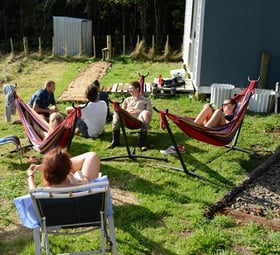
Pupu Rangi is a 100-hectare off-grid sanctuary on the Kauri Coast, Northland — 250 km from the nearest city, 50 km from the nearest supermarket, and 1.5 km from the nearest neighbour. A maximum of eight participants at any one time are doing serious conservation work to protect all native species that live within. This is not an injured wildlife sanctuary near a city. It is an off grid camp next to forests where no one has walked in generations. You will be among the first people to enter it.
You should come and join us!
What you can expect
The Pupu Rangi Nature Sanctuary welcomes you to this place of learning: about the forest and its creatures, about conservation, about what is important in life, and about yourself. You will be challenged on many fronts: living off-the-grid, working in a dense rainforest forest, questioning the need for many of the things that we take for granted. You will meet people from various countries and different backgrounds and together with them you will experience something that is rare these days: the expanse of an uncharted forest which you and your fellow volunteers will help preserve.
While at the sanctuary you will have the opportunity to learn about different aspects of life (living in tune with nature, discovering what is really important to you, what other cultures value most), to get some practical skills (planning, setting priorities, using creativity to find solutions within the available means), to learn about New Zealand native species and the different ways to protect it, to understand what it takes to live in a sustainable way, and to explore the attractions in the surrounding region. Body and mind will both be exercised and enriched.
The program
This program has three components: the conservation work that we do in the forest, the manual work that we do around the sanctuary, and the sightseeing that we do around the region.
Volunteer work
Some of the tasks that you will complete are:
- cutting and marking tracks
- installing, refilling, and monitoring bait stations
- installing and monitoring traps
- kiwi, kokako, and rodent monitoring
- seed collection
- weed control and planting of native plants
- data entry
The conservation tasks that we perform in our sanctuary and on the behalf of the Department of Conservation (DOC) are performed at a professional level, and you will receive the training necessary to reach the required high standard.
Week 1–2: You learn the protocols. Navigate the dense forest, look after your safety, predator control, trail camera kiwi monitoring using DOC methodology. You'll be working alongside an experienced conservationist from day one — not observing.
Week 3–4: You know the forest. You're running trap checks by yourself, you can confidently go further in the forest, you spend the nights alone in the forest listening for kiwi. Participants consistently say week three is when the experience changes.
Week 5+: For those who want to go further, extended stays and formal internship pathways are available — including a university placement letter and skills log.
Manual work
The manual work part of the program refers mostly to the activities that we have to perform to maintain and enhance the living area. It is most likely that most of the tasks that you will have to perform will be new to you. We will train you and you will use your creativity and previous skills to find ways of completing the tasks.
Tasks include:
- weeding and maintaining the herb garden
- building maintenance tasks (i.e. painting walls, setting up walls)
- landscaping
- chopping wood
- general help around the place
Previous volunteers helped us paint the accommodation buildings, start a herb garden, paved a patio area, built sheds, erected fences, and built an outdoor bath.
Every month, week, and day has its own target tasks to complete be it monitoring, track cutting, or some facility improvement. In general, we aim to find a balance between the conservation and maintenance tasks.
Relaxation
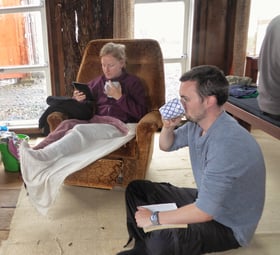
The third component of the program consists of the relaxation activities that are so important to recharge one's batteries. We believe that it is important for each volunteer to see the extent of their contribution in the wider context of the Kauri Coast region. We are also proud of the beauty of this land and it will be our pleasure to share it with you.
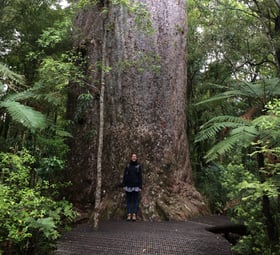
At night we might go on a safari looking for kiwi, these three hour night walks are an amazing opportunity to hear the sounds of the forest and let the stars guide us. Sometimes we also go deep in our forest to visit the glowworms that live near one of the waterfalls. There is nothing as magic as sitting in the dark by the creek and watch the tiny blue lights of these amazing creatures. One day a week we head to the lakes for some swimming or SUP practice, or we head for a long beach walk (or mountain climb), or we visit the amazing two thousand year old Tane Mahuta - the oldest and biggest tree in New Zealand.
Why Pupu Rangi, not Australia or another New Zealand programme?
Australia's conservation programmes put you near a city, caring for animals in enclosures. Other New Zealand programmes are city-based rotations in Auckland or Christchurch. Pupu Rangi is field conservation in the animals' actual wild habitat — predator control, kiwi monitoring, habitat management — in a forest closed to the public. The methodology you'll learn is used nowhere else on Earth.